

Probably Shouldn't Trust Me (YET) To Wire Your Fire-Alarm
- Samantha H.
- Dec 14, 2022
- 3 min read


Another challenging....challenge. This week the mission was to drive a motor with sensors. I had lots of ideas, and this project morphed repeatedly during the week. I tried several different sensor (flame-detector sensor, temperature sensor, and light sensor), and several different builds since I didn't have all of the components in my kit that I was seeing used in online tutorials. I have included photos/videos of the builds and codes that I tried, and finally some afterthoughts, (which might require a tangent or flashback to drive my findings home).
Here goes:
Before I had any real direction or ideas about what I wanted to created, I spent time figure out how to get a sensor and a motor to communicate. I was able to set up the "stepper motor", and get it to move. Adjust its speed; but I could not get the photo-sensor to trigger the motor. Anyways, the stepper did not provide enough noticeable movement to be visible on video. I went back to thinking.The first idea I had was to create a pretty simple, and very commonly found sensor/motor combination. I did not have the component (driver?) most of the tutorial showed, and so I had to find the end of the internet to figure out how to get around that. Results (code) below:


From the photos above you can see the evolution of this project. First/second- two different attempts, and many builds in an effort to build a fired alarm. Third- Changed my mind and decided to create an alarm that would go off when the light in the room was bright enough to signal that the sun has risen. Still no luck. Last- An attempt to create a high temperature alarm.
This first set of photos gives you a taste of the preliminary experimentation with the stepper motor, and light sensor.
Then the thing started to metamorphose. I got rid of the stepper motor in favor of the servo, then exchanged the light sensor for a flame sensor, and eventually added an LED and buzzer for the full "fire alarm" effect:.







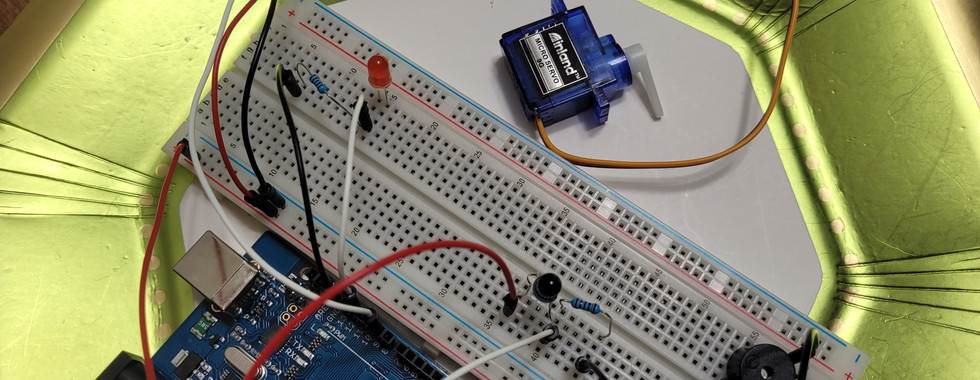


I eventually decided that it might actually be necessary to have the additional device to the flame sensor, or that I had no idea what I was doing with the code, and moved on to a different sensor. For this build, I was going to meld my fire alarm into a high temperature alarm complete with the buzzer, servo motor, and LED. I was able to find code for the servo, I already knew how to work with the LED, and started to feel a little frustrated and disappointed with the sensors. I found an Arduino library specifically for my HDT11 temperature/humidity sensor, and I felt confident that I could see the light at the end of the tunnel. Results below:
and another.... (turn on your sound for full effect)
This project was so involved! It wasn't the building part that took a lot of time; I made at least four in a total of twenty minutes. The coding, the research, the debugging....that is what took all the time.
My conclusion:
Perhaps I have missed the mark on this conclusion. It is my understanding that makers spend a crazy amount of time in the beginning researching and learning before they are able to start actually creating. Once the basic skills are there, everything else just flows, and then a maker is able to really explore his/her quandaries. I also have an incredible admiration for people who work to ensure public safety (fire alarms, over temp alarms in power production plants, etc.), and I am not sure that I will ever be able to these safety measures for granted again.
I am going to keep playing with the code to figure out how to get my sensors to respond the way that I want them to, but until then: please don't trust me to wire up, inspect, or program your fire systems. It might not end well.
One last photo I wanted to include in case you're curious.

Take care y'all!


Comments